Showing posts with label boston. Show all posts

Wednesday, August 06, 2008

Zander Conducts the "7 Habits" Set


I recently found this video of Benjamin Zander, best known to me as conductor of the Boston Philharmonic, giving a talk at TED. Techniques of evangelizing classical music seem diverse, but this is the second time I've someone use phrasal analysis (in a sense). However, instead of an affable family-friendly crowd, this is a CEO/high executive crowd whose time is really fucking important to them who, granted, are spending a week at an invitation-only wonderland conference. Conservatory students are remarkably similiar in being overprotective about their time, but unlike CEOs they aren't at all interested in optimizing or streamlining or really other people at all, hence the slow choking death of "student life" at most such institutions.

Zander's humor and good nature make me wish I had seen the Boston Phil more often, having only seen them once when Sharon Isbin rolled through to play the Concierto de Aranjuez. Coincidentally or not, this was two weeks before Pepe Romero played the same piece with the BSO. While I made several jokes about the battle for the rights of "Boston's second best orchestra", the Boston Phil and BMOP seem more and more like two sides of the same coin: more nimble and adventurous than the elephant across the street can be. If one can call a Mahler cycle over four years nimble.

P.S.: On a Boston-related note, Go Revs!

Sunday, May 11, 2008

You Can Rock

A couple days ago I found myself in the women's dressing room backstage at Berklee's Commencement Concert. A compatriot of mine was playing (oboe!) in the shenanigans and promised lights, smoke machines, and Ornette Coleman. Two of these three were satisfied.

As my time in Boston comes to a close I think back on how Berklee has confused the living hell out of me. The concert I attended was not the graduation itself but essentially a rock show honoring their honorary doctoral recipients: Steve Winwood, Howard Shore, Rosa Passos, and Philip Bailey (the guy who sings real high for Earth, Wind, and Fire.) Other than ringers from the Conservatory (most of the windwoods, a horn, and the entire viola section) the performers were all from Berklee, many graduating seniors. It was throughly enjoyable with a couple exciting moments on both ends of the quality spectrum, but it all seemed too precious.

Despite having played in a rock band for n years, this was the first time I'd been backstage at a freakin' arena with its backline and its confusion. I don't know of they are required to give solo recitals, but I imagine that's practice for the bar circuit and this is the dry run for Making It to the Big Show. From a seat where I could see the wings it was often times an effective show, while it occasionally lapsed into feeling like a high school talent show except with an audience of 5,000.

I'm not going to explicitly say that there was a noticeable difference in orchestra between Berklee and Conservatory players. I will say that the Berklee students were oft found quoting their discarded motto "There's Nothing Conservatory About It." Whatever, I get that their forging a new tradition and intentionally spurning anything to separate themselves. (Have you seen their crest? It that fucking Helvetica!!!) However, there still is the awkwardness of the academizing of something that really rejects it. The honorees for the most part had nominal roles in the concert, either performing or conducting one piece. Steve Winwood however was not expected to arrive and a Berklee senior was tapped to sing instead. He did end up leaping on stage and she was decidedly unable to roll with it.

I don't mean to be dismissive of Berklee. Its the only place you can go if you want to rock and actually treat it as a craft and unlike every conservatory in the world it acknowledges the music industry, something shadowy, amorphous, and altogether evil, and attempts to codify and dissect it in some manner. I'm just confused by the place, and I still listen to metal.

Wednesday, February 06, 2008

Subjective Greatness

Through the usual channels of circumstance I scored tickets to last weekend's Celebrity Series gig at Jordan Hall, being told only that it was a Gershwin something or other. I can't exactly say I'm a musical theater man, but despite not having had the chance to crack Alex Ross's book I'm familiar with its opening vignette. Turns out the thing was a lecture-recital by Rob Kapilow, a jack-of-all-trades who has clearly found the meth stash in the PBS Kids hosts' lounge.


My immediate reaction was to fold my arms like a hipster, but Kapilow does hit on that age-old question of how to sell concert music to the masses. And this guy was doing it. His tricks are probably familiar to anyone who has heard his "What Makes It Great" programs (unlike me, who I realize appear to live in a complicated network of Afghani caves) but he had an audience doing phrasal analysis and apparently enjoying it. And this was a very polarized audience, I would assume that we were of the few audience members between the ages of 10 and 60.


I maintained my arms akimbo stance until a point where Kapilow pointed out a riff in "They Can't Take That Away From Me" that Gershwin knicked from Beethoven, a classical theme that Gershwin slaps some altered chord tones on. Not only did this jam home how much Gershwin was getting the chocolate in the peanut butter but I noticed that this was Kapilow's one foray into musiclogical esoterica that he seemed always on the verge of spinning off into. His ethusiasm and depth of knowledge were clearly sufficent to roll with the big boys, but he kept it restrained if you can use that word to describe him. It was remisicent of fiery instrumental playing at its best. A train that seems bound to come off the tracks, but never. Actually. Does it.


Watching the success that Kapilow connected with the crowd made me consider that the line between accessibility and jargon is not where I think it is. (i.e. the path to appreciation is significantly different than that of most theory/history cirricula) Whereas he went into phrase structure with detail, other topics were dealt with thusly:

Q: What kind of chord is that?
A: An awexome one.


My only question is that I saw him work this show with Gershwin songs, works that no one would percieve as "inaccessible". The thorniest work his website offers is "Death and the Maiden", so Xenakis and Andriessen will have to wait for their champions. Nonetheless he's coming back in April to pimp out the Waldstein sonata, so I might have to check out how he treats a work that's a little less immediately digestible.

Sunday, October 21, 2007

53 Days Since Time Lost Due To Injury


I don't know how the rest of you in Internets Land are doing but Boston town has entered a freakish hot spell for late October. Usually the playoffs are when you have to bundle up to sit outside but I had to open all the windows in my apartment and actually punch new openings in the walls for it to cool off. I've been looking for a picture of someone wearing summer gear in front of a changing tree for the past couple days but I fear that idealized picture only exists in my head. Besides it would difficult to capture with the Populist. (I'm almost done with this roll guys, I swear.) Good thing global warming is a hoax.


My weekly lesson was moved to Saturday this week, a cause of anxiety because due to my work schedule most of my extended practice time comes on what I would previously have referred to as a "weekend". However after it was over I found myself taken back by having a Saturday without the impending stress of my lesson. It was really just a few hours of not having something due right fucking now. Unsettling.


Now having done a bit of math while I'm at work now I've realized the last day I went without stepping foot inside the Boston Conservatory was August 29th. I'm going to start a counter like they have at construction sites, and to be quite honest this is a trend I expect to continue until Thanksgiving. I'm relatively sure that every pretentious academic like this where they find that grad school is not the Diet Life that they are mocked for and then go on a crabby streak when they contemplate how it is supposed to get worse than this.

Picture source, the cartoon appears to be signed but I can't make it out.

Tuesday, September 04, 2007

I'm Shipping Up To Boston

Actually I'm already here, but what's more Boston than a Dropkick Murphys reference?

Posting should improve, I realize this is primarily because I'm back at a job that places me before a computer for hours at a time.

Most of the recent days have been spent moving into my new apartment. Whereas all of my classmates have retreated to the suburbs I've stubbornly remained in the Fenway. I watched a special on Boston during the summer on High Living or some other useless digital cable channel and was irked when the local hotspots they mentioned avoided Boston proper entirely. However, as I watched the bevisored masses carry up leather couches and big screen TVs and cinder blocks to put the couches and TVs on, I realized that no local in their right mind would pay the rent to stay so close to the center of town. Either way, as I cleaned up my apartment listening to Josquin, I began to relish my inevitable role as the weird guy at the end of the hall.

I might resume my If I Ran The Zoo bit once the season gets going and if my hazy understanding of Google Analytics tells me anyone read that to begin with.

Wednesday, June 06, 2007

By Succeeding I am Failing to Fail

Things I somehow didn't do in my first year in Boston, and may be inexcusable.

  • Go to the top of the Pru. I managed most other touristy things like the Freedom Trail, but this one eluded me. I did however point to the top of the Pru during orientation week and declare if we didn't go to the top of it within that week we never would. This has held true.
  • Go to a goddamn Red Sox game. This isn't so inexcusable considering that tickets are somewhere in the realm of eleventy billion dollars, but it was infuriating considering I could see Fenway Park out of my window.
  • Go to a show at the Middle East. I sure may not have any at all indie cred, because the amount of hipsterati weird at the epicenter in Cambridge should have been a siren song to tempting to resist. Even worse is that I only really went to two (2) rock shows the whole year.
  • Fung Wah it to New York. I suppose not really a Boston thing, but plenty of other new music wonks will tell you that it is the Center of the Universe. Alas, I wasn't able to clear out a weekend so I could hang with my posse icelu.
  • Go to a show at regattabar. See Middle East entry, replace indie with jazz.
  • Meet any other Boston music bloggers. Most especially you, Mr. Guerreri. Isn't that library you mention on occasion the same one I work at fifteen hours a week?
Did I miss anything really crucial? My activities have been rather Back Bay-centric. As you see most of my failures are outside those bounds. I have at minimum one year to correct these errors.

Saturday, March 24, 2007

You Live In The Universe This Whole Time

Big ol' drought. That was weird, sorry about that guys.

The Conservatory was on spring break this past week and my parents came up while I had some time off, thusly I did all the touristy nonsense that I have neglected in the six months I've been here. It's been great. I actually have a couple stories that the populace might be interested in, but in the interest of actually posting something I'll only tell one (for now).

I've already mentioned twice that I talk a big game about cuisine when I rarely actually delve into details and can barely afford to eat at restaurants that convienently price their items at one dollar each. This could potentially change; I've started to reach critical mass with music blogs (especially the prodigous output of ANABlog and On an Overgrown Path) and rather than prune this extensive forest I've actually retreated to foodie blogs. (Michael Ruhlman and Harold McGee are my favorites at the moment, although Ruhlman is on sabbatical until April. His post has been taken up in his stead by Bob del Grosso and the ever lovable Anthony Bourdain.)


Traditionally this is a fantastic place for one's parents to step in, we did go to some fantastic restaurants. This tale takes place at not the best of them, but at a notable one. We braved the Freedom Trail on Monday (coincidentally the coldest day of the trip) at stopped at Todd English's Kingfish Hall. I personally had no idea who the man was, but my parents proclaimed him as "the guy on Saturday afternoon". If you've ever been to a restaurant titled after a dude in a different city than said dude, you already know how these places roll.

Nonetheless, I was embarassed that I was impressed by some rather entry-level plating tricks. My fries came in an oversized martini glass, the salad was stacked in a layered tower, yes yes. The food was certainly good and very signature chefy, clever variations on familiar themes. But you can tell that this was most likely a Epcot version of the real deal, separated by a few steps from Todd English himself. Like a child who's just learning to crack jokes, it seemed occupied by making sure you knew how clever it was.
However, upon coming to this realization, my dad rather nonchalantly asks the waiter if that's his boss over at the corner table. Sure enough, we have been in the presence of Mr. English the whole time. Alas...

Sunday, February 25, 2007

I'm Probably Still Voting In Illinois

In case any of you are interested in the Boston concert music scene and don't read Soho the Dog (i.e. none of you), radio journeymen WCRB are polling for Boston's Top 100 Classical Pieces of all time. Clearly something must be done about this. Having seen the power of a party system, a brief list of decidedly un-relaxing American works have been assembled under Matthew's supervision.


However, in my own gross self-interest I would note that a great deal of discussion has already occured about Steve Reich's Four Organs, a piece I have occasionally shown some interest in. Not to mention Four Organs's history in Boston. However, since the importance of the work within the framework of concert music might be a little spurious, I wholeheartedly endorse another party candidate: Frederic Rzewski's The People United Will Never Be Defeated. Now, if I only I actually owned a terresterial radio.

(As a side note: While I do hail from northeast Wisconsin, I was actually born in Peoria, Illinois. Thusly I am highly confident that my generally leftist pinko commie vote counts double.)

Thursday, February 15, 2007

If I Ran The Zoo: Feb 15-18

Let's try a new Idea. A brief concert calendar of what I would see each weekend if I had all the money in the universe. I'll list runners-up so that there's some concert music on here each time even if I decide to go to a metal or jazz show. Also there will be a concentration of free concerts and concert at the Boston Conservatory, since I've got me a recital attendance requirement.


Thursday: BSO performs Haydn (not bad since I'm in a Haydn class now anyway), Wuorinen (world premiere!), and Brahms 4.

Friday: Alarm Will Sound plays music of Conlon Nancarrow, eat babies, enslaves civilizations. All at the Isabella Stewart Gardner Museum.

Saturday: Dark Elegies, a Mahler mash-up perhaps inspired by Uri Caine's continued success. Also dancing! TBC Mainstage Theater.

Sunday: Roger Tapping, violist for the Takacs Quartet and new TBC faculty addition. Sorry, can't think of anything snarky for this one. TBC Seully Hall.

And yes, two posts in one day. I know.

Five more for Igor

NEC is having a Stravinsky brouhaha to try and match our Webern festivus. Except they're doing Firebird with choreography so I guess they win. But what interested me was the intriguingly title gem (i.e. free concert) "Rarely-Performed Masterworks". Now I don't know much about Stravinsky, embarassingly little outside the big three "Russian" period ballets, but I felt like a had a bit of street cred for having heard one of these masterworks. Or maybe the performers should having known to perform it? meta meta meta......


The program provided deep cuts from all these of the official Stravinsky period, the first Russian (or "primal" for the less educated types) period was represented by his Three Pieces for String Quartet of 1914. It is well noted that they aren't grouped under some more binding term, like "suite" or "string quartet", since the bracing rhythms of the Dance were as far away from the glassy chords of the Canticle as anything else on the program.

The balance of the first half jumped to his late serialist period. I had already heard the Three Songs of Shakespeare, but this quartet provided a much more interpretative and dedicated performance. As opposed to the twelve-tone rows favored by the Viennese gentleman, the three song are based on four, five, and seven-tone rows respectively. I had missed the subtle move from quasi-modal to the atonal kaliedoscope before, but the performered shifted their tone to accentuate it. And thank the Jeebus the soprano knew what she was talking about this time.

Its companion piece, In memorium Dylan Thomas, was at turns bombastic and hushed (really your only options with four trombones). I can't suppose whether Stravinsky was devastated or merely bummed at missing the chance to work with Thomas, but he uses the system to great effect. While stopping short of grief, the canon of trombones exuded a guarded respect.

A Lee Hyla piece Amnesia Breaks was offered as a sort of intermezzo before the intermission. It could've stomped pretty hard, but I couldn't tell. The performance was either totally phoned it or embodied everything we have come to fear about conservatory playing. Glued to the page, refusal to get violent and charging through the tender parts, it was a mess.

The second half promised to larger-scale works from Stravinsky's neo-classical period, which is sort of a vacuous hole in my knowledge. The chamber orchestra's Concerto In D was a masterstroke, it really does sound like Haydn if he had the chance to hear the next hundred years of music. My personal favorite comes in the second movement, the violins are gifted a pretty if somewhat pedantic melody. But that's not enough, they want to get fancy. Like the jerky string players they are they get more and more lost before just stopping, luckily the violas and cellos lay down a big V-I and everything starts over again. It isn't Haydn without jokes.

In lieu of program notes John Heiss, the director of NEC's Contemporary Ensemble, spoke briefly before several of the pieces. I liked how this opened up the flow of the concert a bit, Jordan Hall always seems to be a more relaxed and artistic place than Symphony Hall, but provided the chance for an "ah-ha" moment normally regulated to lectures and magic shows. Before closing with Stravinsky's Mass, he brought us back to those crystalline chords in the string quartet at the beginning of the concert. When asked why they were there, Stravinsky responded "The cantors need time to swing the incense." It was a cool moment.

This moment was ruined, the Mass is a godawful piece. Nevermind the lackluster Bach consort or the poor blending from the Chamber Singers, the piece is bad. I can think of no other way to describe it other than it sounds as though it was written for high school choir. Some things are rarely heard because they were ahead of the curve or circumstance caused them to slip through the crack, but sometimes it is because it isn't very good. One neat thing I managed to glean from it was its continuation of the Palestrina tradition of homophony when you really need to hear the words. The machine gun-like pace of the Credo may have been meant to play behind interesting figures in the winds, but the winds certainly weren't making it sound like that. One brief glimmer of brillance came at the end of the Credo, after the aforementioned march the Amen blossomed into what seemed to be infinite shards of tradition. That might have just been by comparison.

Stravinsky certainly has his pedestal, George Perle said that when Stravinsky died that the world was without a great composer for the first time in six hundred years. (Josquin? Really?) As I type this I'm staring down a copy of Igor's Poetics of Music on loan from a friend that I didn't read in time but wish I had. For a composer whose main fame with the populace caused a riot, seeing these smaller works brings out an appreciable side of a figure that will likely only grow more inaccessible with time. But don't take this as a suggestion that we should start trotting out Beethoven's Scottish songs and mandolin variations.

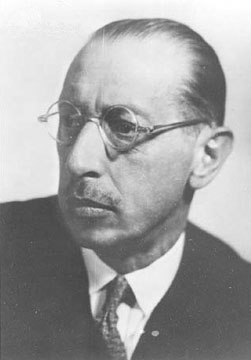
Photo from nndb.com

Thursday, February 08, 2007

Big Jimmy Stands Up for the Sforzandos

Tonight will be the first Thursday in a month that I won't be attending a BSO concert. (For free at least, a gentleman friend of mine is coming in for the weekend and we might go student rush.) They were good concerts both, clearly, and the Globe would do a better job of summarizing them for journalistic consumption. I will go the more bloggy route.


Both programs featured an even-numbered Beethoven symphony, oft numerologically maligned in the same manner as odd-numbered Star Trek movies. (Although one could have their opinions about Nemesis...) With such a historic bias, I'll admit that my lacking knowledge of classical symphonic works tended to skip over them. This is part of the continuing saga of my backwards musical education, I knew that Wagner wasn't down with the Eighth before I ever even heard it. The Sixth on the other hand, clearly is wuss music.

Two weeks ago was Sir Colin Davis pairing the sixth symphonies of Vaughan Williams and Ludwig van. Before I really delved into his works I often dismissed Vaughan Williams as being wuss music himself, but his sixth symphony is as close to a metal beatdown as I've ever heard traditional forces get. Beethoven's Sixth is wuss music, but after the VW it was goddamn necessary. Although the salient theme of the program fell short of revolutionary, both symphonies also played with the four movement expectation. VW had four proper movements but they were all attacca as most future minimalist onslaughts would be, but for all the smack that Beethoven 6 recieves the storm interlude is actually fiendishly clever. The program notes (written by one Jan Swafford) write off the storm as not a separate movement, retaining the four movement form and hence why I call it a interlude. I'll believe anything that man says. This subtle, or not since it might be the most bombastic Ludwig van gets, bridge is something I've totally missed when listening on CDs.

As an aside, the only recordings I have of the Beethoven symphonies is Claudio Abbado's set with Berlin from 2000. This set hits it like the Count rather than frog & dog style, so the even symphonies are placed after the more exhausting odd ones on each CD. I tend to zone out.

Last week was I my first time seeing Big Jimmy conduct, but I wasn't really sitting close enough to be able to analyze and hypothesize. Except for when he got out of his chair during the Coriolan overture. It was the penultimate concert of his Beethoven/Schoenberg throwdown, but it seemed like the program really built around Schoenberg's chilling Erwartung. As I said earlier, I have my issues with atonal song so the prospect of a one-act operatic monologue wasn't particularly appetizing. Entirely the opposite, the lack of musical memory in either direction allowed Schoenberg to employ a sort of mega-eXtreme madrigalism.

The various Beethoven was pretty good, but the audience reaction made me start to think that maybe classical music is dying. The average listener is told before going to the concert hall that they're suppose to adore Beethoven, and they are even reminded upon actually entering Symphony Hall. The BSO audience doles out encores like candy anyway, but the two callbacks after the overture were totally unneccessary. It's an overture guys, get back to the rock! The reaction following the Schoenberg was expectedly cooler, but the audience after the corresponding Beethoven scene and aria was totally rediculous. Deborah Voight clearly laid it out for the Schoenberg, "Ah! perfido" seemed a little airy and melodramatic after such a tour de force. But the people will do what they are told.

One of my friends here in Boston wrote a paper on the Eighth, and his recommendation combined with the previous week's solid case for the Sixth led me to actually look forward (!) to his oft-skipped symphony. It's a fun piece, and just as people know they are suppose to like Beethoven, they know that they don't want their Beethoven fun. The epic hallmark of great composers is the manipulation of expectation, and the defining moment (for me anyway) was a quick rainstorm of triplets in the second movement. All I wanted was a quick burst like that again, he gives us a fourth movement that is nothing but. What a jerk, no wonder everyone likes him.

Tuesday, February 06, 2007

Fotografuję, żeby pamiętać

A lot of rediculously awexome bands were formed at art schools: Talking Heads, Pink Floyd, King Crimson, to start. But how many really awexome bands came from music schools?


Exactly. By the way, the answers would have been Dream Theater (Berklee), Alarm Will Sound (Eastman), and Kneebody (also Eastman). One drawback of attending a conservatory is not being able to bounce ideas off of students of other disciplines. If not for all the art majors I hung out with last year, I would have no idea that I hate Matthew Barney (kind of) and no idea what post-feminism is. Not that anyone does.

Being a bit of a pinhole photography enthusiast and of vaguely Polish descent, it would have been silly not to attend "Made In Poland: Contemporary Pinhole Photography" at the Art Institute of Boston. The problem was that it was a little silly, upon arriving for the gallery talk I immediately got the sense that I was at a party that I wasn't really invited to. The crowd was easily divisible into three groups.

1) A close-knit fifty-something group of curators and art collectors
2) Ferocious cliques of Art Institute of Boston students
3) Pinhole photographers who only speak Polish

The exhibit was fantastic, but didn't really have any sort of confidence of why I was there. I showed the Populist DX to anyone to who would listen, but the responses ranged from detached curiosity to dismissive to the point of insult. Highly discouraging to say the least, in retrospect I should have returned on Saturday for the Meet the Artists/Portfolio Sharing event but since I lack one those too....

Whatever, fuck 'em. I can't recommend the exhibit enough, Poland is touted as a budding center for contemporary pinhole work and the pictures certainly supported that. I'd try to single them out but each of the seven artists presented approached the box-o-film so distinctly and uniquely that I'd drown the blog. Their individual websites are accessible from the exhibit site.

The curator's note echoes a lot of the reasons that I like pinhole photography, other than that my dad gave me a sweet camera: an inherent inclusion of the passage of time, and a refreshingly proletariat economy. This latter point was the real cause of frustration with a couple people at the exhibit. (Along the lines of: "Isn't this one of those kits you can buy?" "No, motherfucker! You make it!") Anyway, with such stunning examples to draw from maybe I'll try something other than pointing at something I see on the streets.

The exhibit runs until March 4 at the Art Institute of Boston and returns for round 2 from May 25 to September 16 at UMass Dartmouth.

Saturday, February 03, 2007

Hylastic

I've been promising a post about this for a coupla days now, so I better deliver. I've been trying to go to more free concerts, in addition to the seven on campus performances that it is imperative that I attend in the interest of my degree. The BSO College Card has been coming to the rescue lately, but NEC has actually been filling in the gaps nicely. To the point were I actually rallied some troops to attend Lee Hyla's sendoff on Tuesday. I was tipped off by Darcy James Argue, a former student of his, and its hard to argue with free. However, I didn't do my research (probably worried about hitting a deer or something, I'll explain that later) which I realized at the moment the saxophonist inhaled.


This first piece was "Pre-Amnesia", and judging from the date (1979) as compared to the rest of the program I'd say that was either his first piece as a prominent composer or typical of his "freshly mature" style. It was particularly frantic, with sort of an Elliott Carter mood with a heaping helping of impatience.

Stephen Drury performed the next work, "Basic Training" for solo piano, in some rather impressive pants. Pants aside, this was a work of a composer who clearly was more put together. Starting with a single middle C jammed hunt-and-peck style, that single note would unify episodes of increasing insanity. I hesitate to use the term variation, since I don't think there was really a theme to begin with, but each episode was manically distinct in character. Tone rows in one, honky-tonk in the next, only separated by a sixteenth note middle C. "Basic Training" also introduced a theme that would reappear in the majority of the works to follow. The murder and mayhem that seem inherent in much of Hyla's work is tempered by a disarmingly gentle coda.

The next piece, "Wilson's Ivory-bill" was a lengthy song for baritone, piano, and field recording. I'll admit that I have my issue with atonal song, two thousand years of song trains you to expect the voice to have the hook. Without functional harmony to push you along or remind you of where you've been, the focus becomes a lot more vertical than horizontal (as in funk compared to Mozart). However, the texture of the piece is very pointillistic and the field recordings didn't really bring anything. Furthermore, the text is really not poetic at all. The baritone floated in and out of sprechstimme to account for this, which was a neat effect but couldn't overcome the text making the piece as a whole even clunkier. But that coda I was telling you about, a major seventh stacked in fifths. He called in the Chrono Trigger chord and when it hit, it hit like Jesus hits like the atom bomb.

One great thing is that up until this point in the concert, the performances were all by the musicians that originally premiered the works. The last piece before the break was a large ensemble work, a piano concerto in fact, so the logisitics of bringing it back home was tuff. Stephen Drury led a cast of kraazy NEC kids on a wild ride indeed. Over two movements it followed the general form of a concerto, with the slow "movement" divided between the two. Being the first real ensemble piece of the show, the lushness of the orchestration was the first thing to hit. Within the first three minutes every member of the ensemble slid from traditional playing to extended technique and back again, perfectly paced to add a new spectrum of color without sounding chinzy.

However, the high point of the piece, nay the concert, was the several double cadenzas given to the piano and the percussion. Oddly enough, this was the only time the piano really seemed to play out. Anyway, the only way I can describe them is perhaps if Cecil Taylor and Max Roach were in a lightsaber duel with the fate of nations in the balance. All I can say is that percussion had some pretty wicked sack.

The second half of the concert consisted of the Boston premiere of his saxophone quartet "Paradigm Lost" and his big hit "Pre-Pulse Suspended". Hyla himself marks "Pre-Pulse" as a turning point in his career, the mythical fusion between concert music and rock and fucking roll. I don't think it rocked as hard as the concerto, mind you, but the glimmers of light are definitely present. Written for twelve instruments, the uniting force was a nervous ostinato quickly tossed back and forth between all of the strings. Generally it was a stream of sixteenth notes, the ultimate punk bass line, but often each player would take liberties with either the pitches or rhythms. These twists in the line reverbated throughout the ensemble like stone dropped in a pond. Similar to "Basic Training" the proverbial stones got bigger (rock, Buick, small moon) and the ensemble became more and more unhinged until the stones stopped and everything reverted.

My apologies to any Hyla fans that think I'm grossly mistreating him, it was four days since the show and this blog is nothing if not a place for me to learn how to write about music. A faster turnaround would probably help. Anyway, it was real cool.

Thursday, February 01, 2007

Mooninites Foiled in Plot to Blow Up Boston

I'm never going to get around to posting about that Lee Hyla concert, because this is simply too rediculous to let go. In case you haven't been newsing it up, a set of Lite-Brites of Ignitnot and Err giving you the finger as hard as they can that were scattered around Boston were mistaken for bombs. Panic ensues, the T is shut down, cats and dogs living together what have you. After all the chaos, the perpetrators are apprehended but not before Turner Broadcasting reveals that they are indeed behind the whole mess. (For an interesting study in journalistic bias, compare the previous cited Globe article with the CNN article, a subsidiary of Turner Broadcasting)


Three things strike me. First, the follow up after the court hearing shows one of the defendants in a surprisingly positive light. Second, I personally saw one of these boxes in Mission Hill. (It appears to be one of them that have been dismantled, although 10 or so seem to be on the loose yet. Ebay!) It lit up and Err flipped me off. I was pleased, remembered that the movie was coming out some time in the near future and continued on my way. I totally forgot about it (and the movie, take that viral marketing!) until this whole shitstorm happened. Could terrar hide bombs behind cartoon characters?!?!?!?!111

The best part was that the news stories made it sound like the entire city had been swallowed by panic. I didn't know anything about it until the backlash starting hitting FanTent. Had it been an earthbomb rather than a technologically advanced moonbomb, I would have been fucked.

Sunday, January 21, 2007

A Tale of Two Orchestras

 I've mentioned both the Boston Symphony Orchestra and the Boston Modern Orchestra Project here before, but I attended concerts by both in the span of three days and couldn't help but notice the occasional contrast and comparison.


The BSO concert I attended was featured Mozart and Haydn, a program which probably wouldn't have attracted me if not the promise of discounted tickets and my recent enrollment in a seminar on Haydn. The discounted tickets ended up not materializing, but providence struck when a scalper was berated by the box office for being too close and she surrendered her tickets to us rather than continue her business outside. What's with scalpers in Boston standing so close to the ticket window?

Clearly the mission of BMOP doesn't allow for a real analogue program, but the concert was as nostaglic as BMOP really allows themselves to get. All the composers have some connection to the Boston area (this can usually be narrowed further to an NEC connection, but I digress...) and have worked with BMOP before, but the program included two world premieres.

The suprising thing is that for both of these concerts I struggled with how I should be listening. I feel that most of this had to with the fact that I didn't really have a program to fiddle with and distract me, during the BSO concert I had pinkeye and couldn't read it (I could barely see the musicians) and the BMOP concert I simply didn't get one. In addition to actually listening to the music more, I noticed some really whacky things about the audience itself.

As a precursor, I dressed up to go to the BSO. Not a suit, I sort of half-assed it but definitely paid attention to what I looked like. Not a moment's thought of it going to BMOP. Accordingly, there were a lot of bluehairs at the BSO, perhaps the Mozart reminds them of their youth. The BMOP crowd was noticeably younger (albeit smaller), part of this is expected since an NEC prof and recent alum were soloists, but there was an extremely unexpected population spike.

Children.

I saw five or six kids with their parents at the BMOP show. I don't know if you could manage that at most concerts that don't have Peter and The Wolf on the dockets, and this was rather uncompromising modern music. Perhaps it was the more relaxed atmosphere of the BMOP show as opposed to the rigid structure of Symphony Hall? Greg Sandow has been ballyhooing the death of the classical music environment for some time, maybe I'll tell him about this and see how he responds.

Tuesday, January 16, 2007

Back to the Light

 Another set of airports for me today as I head back to Boston for Act 2. I'll post if Milwaukee happens to have free wifi, but if all else fails I've got my trusty new pocketbook to corral all my thoughts in. (My lunch in Logan last month was one of the more productive thinking times I've had in awhile.)


This seems like a good time to mention that to prevent myself from going to a coma due to lack of trivia at the end of month I'm tentatively planning on attending Vericon up at Harvard, a nerdfest I'm admittedly going to primarily to meet demi-hero Jeffrey Rowland. However I plan on throwing my hat into the ring at the Verilympics, primarily looking at the Betrayal at House on the Hill event. I notice on the schedule at the Monopoly event is only given two hours, so they must play some extra bloodlusty version of the game.

Friday, January 12, 2007

The Countryside, The Peasants...

Why is it that as soon as I find a sweet place where cool things happen it burns to the ground?


This is slightly incorrect, I heard about Pan9 at the same time as hearing about how they didn't exist anymore. Here's a page where helping can happen, although most of the big events happened already.

Also, if anyone knows any similiar "hippie communes" with sweet avant music, you should let me know.

Monday, January 01, 2007

Boston Without A Lens II

I did do some more shenanigans with the Populist II (PDF) before coming back and haven't gotten my dumb ass around to posting them, until now!!!!11

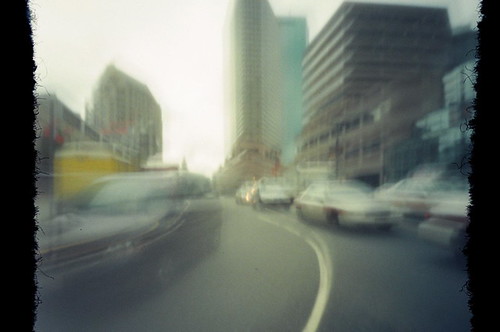
Huntington Ave

This is Huntington Avenue right in front of the Shaw's by the Pru. Almost a decent compromise of movement and clarity. I like it anyway.

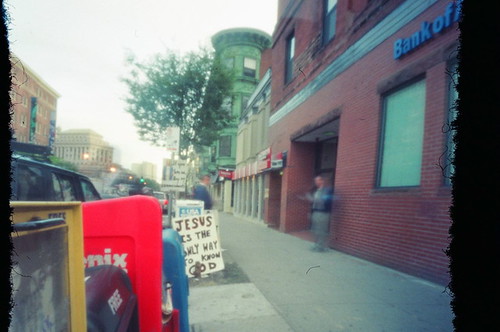
Evangelism on Mass Ave

Earlier in the year I took a bunch of pictures at night with my cameraphone, but couldn't figure out how to get them off whatever memory it has. So I took most of the pictures again with the Populist, this is actually a much more attractive picture of Mass Ave.

Sensorium @ MIT

One thing that'll be cool when I back is that the second part of the Sensorium exhibit at MIT will be up. My dad is the one that gave me the camera, and he digs 2001 so I'm glad that I was able to get a picture here. The three of us are actually sitting on the couch discussing whether the camera will be able to sit there long enough to get an exposure without getting confiscated or otherwise fiddled with.

As before, these are the greatest hits of the larger Flickr set. (I added them to the same one as last time) I have about half a roll of film to burn in Wisconsin before I can use the new and improved Populist III that my dad recently developed.

Saturday, November 25, 2006

BoCo New Music Festival 2006: Finale

I suppose it wasn't such a bad idea to let the all the concerts congeal a little bit before wrapping everything up. My initial underlying bitterness of a new music festival celebrating a composer who died 60 years ago as mellowed some. A festival celebrating a currently active composer, say Michael Gordon or even the birthday boy, wouldn't have as much interpretative freedom with the theme. With the space of time that Webern provided, his influence can be examined as much as his own work.

However, I still wish the the concentration had been on more contemporary music. I was also chagrined to find that the most enjoyable concert of the series was the faculty/student presented panorama of the Second Viennese School. This makes its own sense too. One of the necessary evils with a bleeding edge ensemble like the Argento Ensemble is that the chances are exceedingly slim of packing a whole program of home runs. By definition new music is new, it hasn't had the time necessary to see if it'll stick to the wall. The age old argument of enjoyable and important, perhaps another time.

I'm looking forward to the next one anyway, and I was able to bother a lot of composers about trying their hand at writing some guitar music. (Tossing off some Andrew York at an afterparty didn't hurt either.) Some complicated situations of faculty speaking to other grad students and myself as peers. Except clearly we aren't, they've got a good 30 years head start on this stuff. I don't want to leave parties feeling like I should go study. It's good in its own fantastical way.

Friday, November 24, 2006

BoCo New Music Festival 2006: Day 4

Sorry about the delay, you all knew it was going too well and that I was going to fall off the wagon eventually. Anyway the final night of the new music festival featured conductor Eric Hewitt and his White Rabbit ensemble. Just like the festival openers the Argento Ensemble, these are guys who are actually out there doing it. Nonetheless, after three days of serialesque I had come into this final concert with some preconceptions especially upon receipt of the program notes. I basically spent the whole pre-concert about how I don't like Babbitt very much and how there's no decent electronic music before '95. It sounds pretty stupid now.

This program was presents as the intersection of Webern's technique and American optimism. (In a different way than Ludovico's Cage-n-Feldman fest.) Perhaps fittingly for the end of the festival, the two Webern works acted as relaxations when placed next to the more extended lines of the American works. The first hit was Babbitt's All Set, a serialist piece for the jazz ensemble. I had been trash talking the man, but this drove like nothing else. It didn't sound like the kit was doing any beats, per se, but a pulse was sort of carried by various instruments as a sum. I wonder what sort of jazz Eric Hewitt listens to, his program notes cite Chet Baker and Lee Konitz? I'd say Coleman instead, Zappa more likely.

Like the Berg on Friday, Stravinsky's Three Songs from Shakespeare were a romantic take on tone rows that wasn't that far removed from his own Rake's Progress. The performance was good, except the soprano on the third song clearly had absolutely no idea what she was speaking of. Come on guys, don't sluff off just because it's in English.

The festival as a whole closed with Charles Wuorinen's New York Notes. The piece dates from 1981/2 but at least the festival ended with an active composer. (His Theologoumenon will premiere this season at the BSO.) It's a blistering virtuosic work that features a tape part. This is where things get a little sticky. A lot of electronically generated music gets cheesy way fast, or way boring. Reich famously struck out of his attempts all total electronic music, not mention it obscured the last five years of Zappa's composing. Tone is an issue. The tone on the tape for New York Notes is often buried by the other six parts, and tones Wuorinen used cut through enough. The trouble came with a lengthy "tape cadenza" at the end of the first movement, it played well with others but was extensively irritating by itself. I was concerned that another one would finish the piece and festival. It did end with a tape generated note, but not the Synclavier voice used throughout the rest of the piece. A square wave generated by God himself. Awexome.

After the concert I realized a dig like the piece Philomel, which kind of shot my tape piece and Babbitt prejudices to shit. Festival wrapup tomorrow (yes, a week late I know), which will put me on schedule to start round 2 of the tournament a week late as well. Nice.